
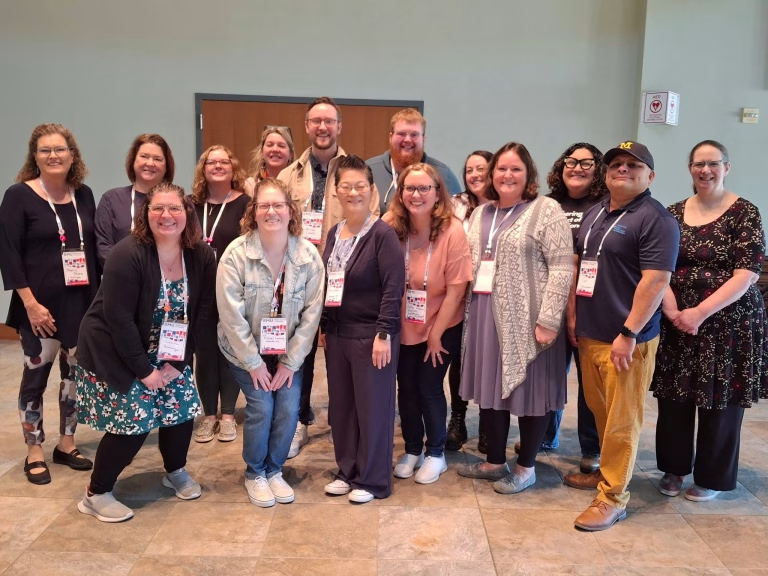
This January I had the privilege of attending a conference in Dallas, Texas, the 2026 Perkins School of Youth and Children’s Ministry. It was a delight to leave the cold, snowy, and bitter winter of Michigan behind for a few days for the sunshine and warmth of Texas! I met 15 other children and youth leaders from the Michigan United Methodist Conference there and had a great time eating, laughing, sharing stories, learning, and worshiping together during the three-day conference. I left feeling affirmed, having learned so much, with new ideas to take back with me, and attended many meaningful workshops. One of my favorites was called “Let the Children Lead,” and it was presented by Rev. Dr. Nelson Cowman, who is the author of the book the workshop was named after.
The workshop began with Nelson telling the room full of children’s leaders to take a deep breath. Then he told us to say to ourselves, “I am not solely responsible for metrics.” It was a good and needed thing to hear. The breath we took was a sigh of collective relief. As leaders in children’s ministry, we feel pressure to grow the church. Well-meaning church leaders and congregants often ask us questions about declining numbers of children and families, (even if the decline happened during COVID and we have steadily seen growth since.) We can’t help but feel the survival of our church rests on our shoulders. This feeling is also true for many in church leadership, especially pastors. The second thing Nelson told us was that the book he wrote, “Let the Children Lead,” was written addressing pastors and senior leadership of the church. (But it is still a great book for all to read, including children’s leaders!) Church life, worship and ministry are more than numbers and more than transactional. We need to focus on, in Nelson’s words, “empowering children to learn and grow as disciples in the context of corporate worship,” rather than just metrics.
In the introduction of his book, Nelson notes that, “Since the mid-twentieth century, polling organizations and new agencies have been sharing about the decline of Mainline Protestantism, and in general, organized religion in the United States. The United Methodist Church, for example, has seen consistent numerical decline in membership since its inception in 1968. For many who were raised in the church – whether in the UMC or in another Mainline denomination – this narrative of decline has been a consistent source of anxiety.” We feel this anxiety each year as we report numbers for each of our ministry areas of our church to the conference.
Nelson then led us through a process to evaluate our congregation’s current worship practices by conducting an intergenerational worship audit that identifies both strengths and weaknesses. This is something that I think is important to do with every church staff or worship planning team. To do this he presented the “Alien Anthropologist Activity,” where we look at the people in our worship, the atmosphere of our worship, the things/objects in our worship, the movements and the parts of service in our worship. Next, we ask these questions, “What are you noticing?” and “What does it look like we love?”
Nelson suggested that for a church to go from audit to action we should consider something from our audit that we would like to address. When we listen to children what is something we noticed about our church or the research that was shared. The church should then come up with 1-2 actionable steps we can take to support intergenerational worship and modify an existing practice or start a new practice. While we do this, we should make sure that there is not any “transactional” underlying logic to it. Nelson shared with us that churches should shift focus from counting numbers to counting blessings. He told us that everyone was created for communion with God. That we should focus on abiding with each other and with God. That we are desiring creatures and we desire what we love. We are what we love. Do we need to recalibrate our values towards God?
Nelson shared with us recent research findings on how children and young people experience worship and how these findings can help our churches design a practical action plan that empowers children to take visible leadership in worship. How listening deeply to children, and asking them, “What would your best worship look like?” can help us recalibrate towards abiding with Jesus. This is how our congregation can bear fruit. Nelson shared this from his book, “if we want children to have a resilient, lasting faith, we are called to form families – not just children. The religious landscape has changed – parents and children alike need support in their faith formation. When churches empower families to practice faith together, both on Sunday and throughout the week, we plant seeds that will bear fruit for generations to come.” He believes in and has a lot of research to share to back up this belief that faith formation happens mostly at home, and churches need to help support families in this.
I think one of the reasons that I loved this workshop so much is that it fits in well with the Making Meaning Together Initiative that my church is participating in this yea. The Making Meaning Together is a grant-funded initiative designed to support congregations to reimagine corporate worship and prayer practices so that children are fully included, engaged, and spiritually nurtured. I am part of a team that is working to help children make meaning out of worship for our youngest congregants and help them become lifelong disciples. The first step of the grant process for Making Meaning Together was to do listening sessions with children. I wondered with children about what their best worship experience was and what they would change to make it better if they had a magic wand. It was a careful practice of deep listening. Nelson writes that, “children are worshipers in their own right, worthy of respect, trustworthy of agency, and are best served by worship practices with all generations present.” Meaning that is not only important but essential to have time in our worship services that we are all together, worshiping together, and making meaning of the worship together.
Through this audit process and the Making Meaning Together initiative I have gratitude for the church I work in. For the ministry I am part of. For the worship planners I meet with, and for the children and families who are part of our church. Our church does a good job of creating meaningful opportunities for children to lead in worship through music, liturgy, acolytes, serving communion and children’s moments. But I now have even more things to bring back to our teams to consider to create worship the best it can be for children and families and everyone who joins us. It was a blessing to be able to spend time at this conference, and particularly in this workshop learning about how to create the best faith formation we can for families and children through worship and ministry.
I recommend reading, “Let the Children Lead,” to learn more about models for worship with all generations. I will end with this quote from Nelson’s book: “If you have been blessed with children in your congregation – whether one or one hundred – then this book is for you. These children are young worshipers whose faith lives are impacted by the witness of your churches and ministries. Regardless of the numbers of children in our programs or in the programs we desire to create, we are called to serve them with faithfulness and authenticity.” To get there it will take patience, creativity and care because the children and families are there, regardless of metrics. And they are a blessing.
- Julia Librizzi, Director of Children and Family Ministries, at First United Methodist Church of Kalamazoo
For more resources about how to help your church let children lead:
Rev. Dr. Nelson Cowan, Let the Children Lead, https://sites.google.com/view/ncowan
Young People & Christian Worship | Samford Center for Worship and the Arts